The Ghana Premier League Through the 4Ps · Part 2
The Ghana Premier League Through the 4Ps: PRICE
What is the Ghana Premier League worth to the Ghanaian consumer?
A week ago, I started a September series looking at the Ghana Premier League through one of the most basic frameworks in marketing, the 4Ps: Product, Price, Place and Promotion.
I began with Product because I believe that before we ask how to market the Ghana Premier League, we must first be honest about what we are actually selling.
Today, I want to talk about Price.
And when I say price, I am not talking only about the amount printed on a match ticket.
I am talking about the broader question of value.
Because in marketing, price is never simply what a customer pays.
Price is what the customer believes something is worth.
A football supporter doesn't only pay GH¢30, GH¢50 or GH¢100 to enter a stadium. They are also paying with their time, transportation costs, food, convenience, safety and, increasingly, the opportunity cost of choosing one form of entertainment over another.
So the real question for the Ghana Premier League is not simply:
“How much should a ticket cost?”
It is:
“What is the experience worth?”
That distinction is important.
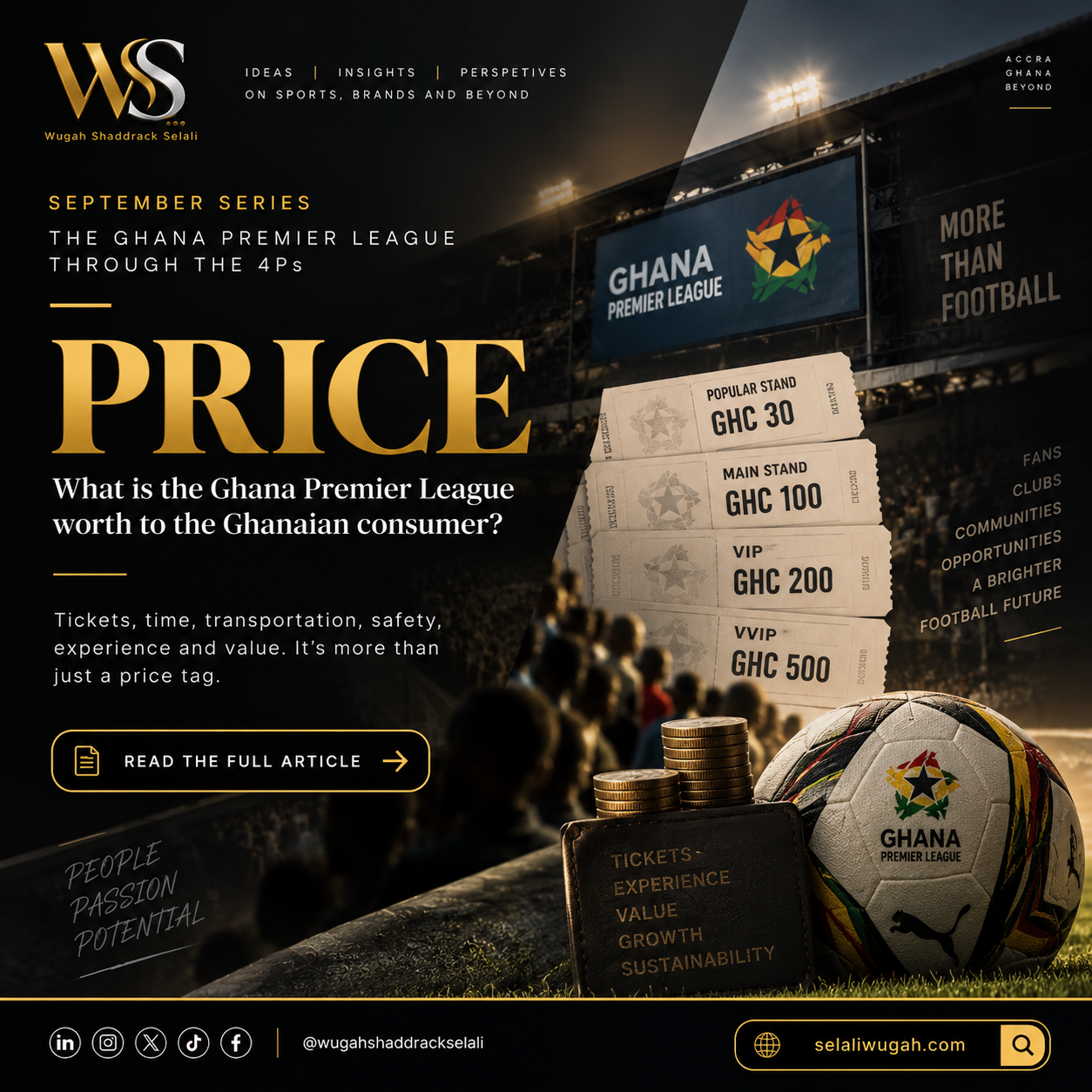
The Ghana Premier League has experimented with different ticket categories and prices. For the 2025/26 Super Clash between Hearts of Oak and Asante Kotoko, for example, tickets ranged from GH¢30 for the Popular Stand to GH¢500 for VVIP.
On paper, that looks like a fairly broad pricing structure.
But pricing is not simply about creating different numbers.
It is about creating different value propositions.
If I pay GH¢30 for a football match and spend another GH¢50 on transportation, food and other expenses, my actual cost of attending the game may be significantly higher than the ticket price.
Now compare that with sitting at home.
I can watch the English Premier League from my living room, often in a more comfortable environment, with professional commentary, multiple camera angles, statistics, analysis and a much more developed entertainment ecosystem.
Suddenly, the competition isn't between a GH¢30 ticket and a GH¢30 ticket.
It is between two experiences competing for my money and my time.
This is where I believe Ghanaian football needs to think differently about pricing.
We sometimes ask whether tickets are too expensive.
But perhaps the better question is whether the experience is valuable enough to justify the price.
Because consumers rarely complain about paying more for something they genuinely believe is worth it.
People pay premiums for concerts.
They pay premiums for restaurants.
They pay premiums for hotels.
They pay premiums for sporting experiences.
The issue isn't necessarily the price.
It is the relationship between price and perceived value.
And this is where the Ghana Premier League has an opportunity.
Imagine if going to a GPL match became more than simply watching 90 minutes of football.
Imagine a properly organised matchday experience, easy ticket purchasing, clean facilities, reliable security, good food, merchandise, engaging pre-match entertainment, quality commentary, fan zones and content that makes the supporter feel like they are part of something.
Suddenly, the conversation around price changes.
You are no longer selling entry into a stadium.
You are selling an experience.
And that experience can be priced differently.
This is exactly why premium pricing exists in sports around the world.
A supporter may pay significantly more for a major rivalry because the perceived value of that particular experience is higher.
The Ghana Premier League already demonstrates this with its biggest fixtures.
The Super Clash, for example, commands a different commercial and emotional value from an ordinary league fixture. That tells us something important.
Ghanaian football fans are willing to pay for value.
The challenge is making the value proposition strong enough and consistent enough beyond the biggest matches.
There is another side to the pricing conversation that we must also acknowledge.
The Ghanaian consumer is price-sensitive.
That means the GPL cannot simply copy the pricing models of European leagues and expect the same response.
Pricing has to reflect the realities of the Ghanaian market.
But being price-sensitive does not mean consumers only want cheap products.
It means they are constantly asking:
“What am I getting for what I am paying?”
That is a very different question.
And it brings us to one of the biggest mistakes sports properties can make: discounting without fixing the experience.
If attendance is falling, reducing the ticket price may appear to be the easiest solution.
But cheaper tickets cannot solve poor facilities, weak security, inconsistent scheduling, poor broadcasting or a lack of compelling content.
You could reduce the price to almost nothing and still struggle to attract people if they don't believe the experience is worth their time.
Price can attract attention.
Value creates repeat customers.
There is also an important commercial argument here.
For the Ghana Premier League to become a stronger business, it cannot rely exclusively on gate receipts.
The GFA has already taken steps to give clubs greater control over matchday revenue. During the 2024/25 season, Premier League clubs were allowed to retain full net gate proceeds, with the Association encouraging clubs to use this as part of efforts to increase attendance.
That is a positive step.
But it also means clubs and the league need to become much more deliberate about revenue per supporter.
The question becomes:
How much is the average supporter worth to the league?
Not just at the gate, but through merchandise, food and beverage, digital subscriptions, memberships, hospitality, sponsorship activations and other commercial opportunities.
The modern sports consumer can generate value in multiple ways.
And this is where the Ghana Premier League has significant room to grow.
The league's new commercialisation strategy with Adesa Productions is already attempting to move in this direction, with investment in broadcasting, marketing and matchday revenue, alongside a GH¢1 million minimum payment to each of the 18 Premier League clubs for the 2025/26 season.
That is important because a league cannot build a sustainable commercial model by thinking only about how much it can charge people at the gate.
It has to think about how much value it can create around every supporter.
And perhaps this is where I would challenge the Ghana Premier League most strongly.
We need to stop thinking of supporters as people who come to the stadium to watch football.
They are customers of a sports entertainment product.
That changes everything.
A customer should be understood.
Their preferences should be studied.
Their spending behaviour should be analysed.
Their location should matter.
Their age should matter.
Their match attendance history should matter.
Their digital behaviour should matter.
Their willingness to pay should matter.
Pricing decisions should increasingly be informed by data rather than simply tradition.
Why should a low-profile fixture and a major rivalry necessarily be treated exactly the same?
Why shouldn't early-bird tickets exist?
Why shouldn't families have packages?
Why shouldn't students have targeted offers?
Why shouldn't season memberships create value for loyal supporters?
Why shouldn't hospitality packages be designed for businesses?
Why shouldn't clubs experiment with dynamic pricing where appropriate?
These are not simply football questions.
They are marketing questions.
And the bigger opportunity may actually be outside the stadium.
The Ghana Premier League could create a much broader pricing architecture around its content.
A supporter could pay for premium digital content.
A business could pay for hospitality.
A fan could purchase merchandise.
A family could buy a matchday package.
A corporate partner could buy an activation opportunity.
A broadcaster could pay for premium content.
A sponsor could pay for access to a valuable audience.
The league therefore needs to move from asking:
“How much should we charge for a ticket?”
to:
“How do we create multiple ways for people to pay for the value we create?”
That is how modern sports properties think.
And there is one more issue we cannot ignore.
Price communicates positioning.
When you price something, you are telling the market what you think it is worth.
If the Ghana Premier League consistently presents itself as a low-value product, consumers may eventually internalise that perception.
But if we improve the product, improve the experience and communicate that value properly, we can begin to change the conversation.
This doesn't mean making the league expensive.
It means making the league valuable.
There is a difference.
The objective should not be to make Ghanaian football unaffordable.
It should be to make the supporter feel that attending, watching, following and engaging with the Ghana Premier League is worth it.
Because ultimately, consumers don't buy prices.
They buy perceived value.
And that is perhaps the biggest pricing lesson for the Ghana Premier League.
If we want people to spend more on the league, we must first give them more reasons to value it.
If we want sponsors to invest more, we must create an audience that is valuable.
If we want broadcasters to pay more, we must create content people genuinely want to consume.
If we want supporters to return every weekend, we must give them an experience worth returning to.
The price of the Ghana Premier League is therefore not just the number printed on the ticket.
The real price is determined by what the market believes the league is worth.
And that brings us to the uncomfortable question:
Are we pricing the Ghana Premier League according to what it costs to run, or according to the value we are creating for the consumer?
Because those are two very different things.
The answer will determine not only how much supporters pay, but how much the entire Ghana Premier League ecosystem can ultimately become worth.